Laundry Room Folding Table: How Can You Create the Perfect Folding Station?
A laundry room folding table gives you one of the most useful upgrades you can make in a laundry area: a dedicated place to fold, sort, stack, and organize clothes without taking up valuable floor space. For many homes, the best solution is a countertop over a front-load washer and dryer. In smaller rooms, a wall-mounted drop-leaf table or fold-down laundry table can provide the same function while disappearing when you need more room.
The right design depends on your washer and dryer setup, available wall space, table material, storage needs, and how often you do laundry. A well-planned folding station can also work alongside smart appliances, lighting, sensors, and home-automation routines to make laundry day easier.
This guide explains the most practical laundry folding table ideas, how to choose the right material and size, how to build one safely, and which design works best for small laundry rooms.
What Is a Laundry Room Folding Table?
A laundry room folding table is a dedicated work surface used for folding clean clothes, sorting laundry, treating stains, organizing baskets, or preparing clothes for ironing.
It can be a simple portable table, a built-in countertop, a wall-mounted folding desk, or a custom surface positioned over a washer and dryer.
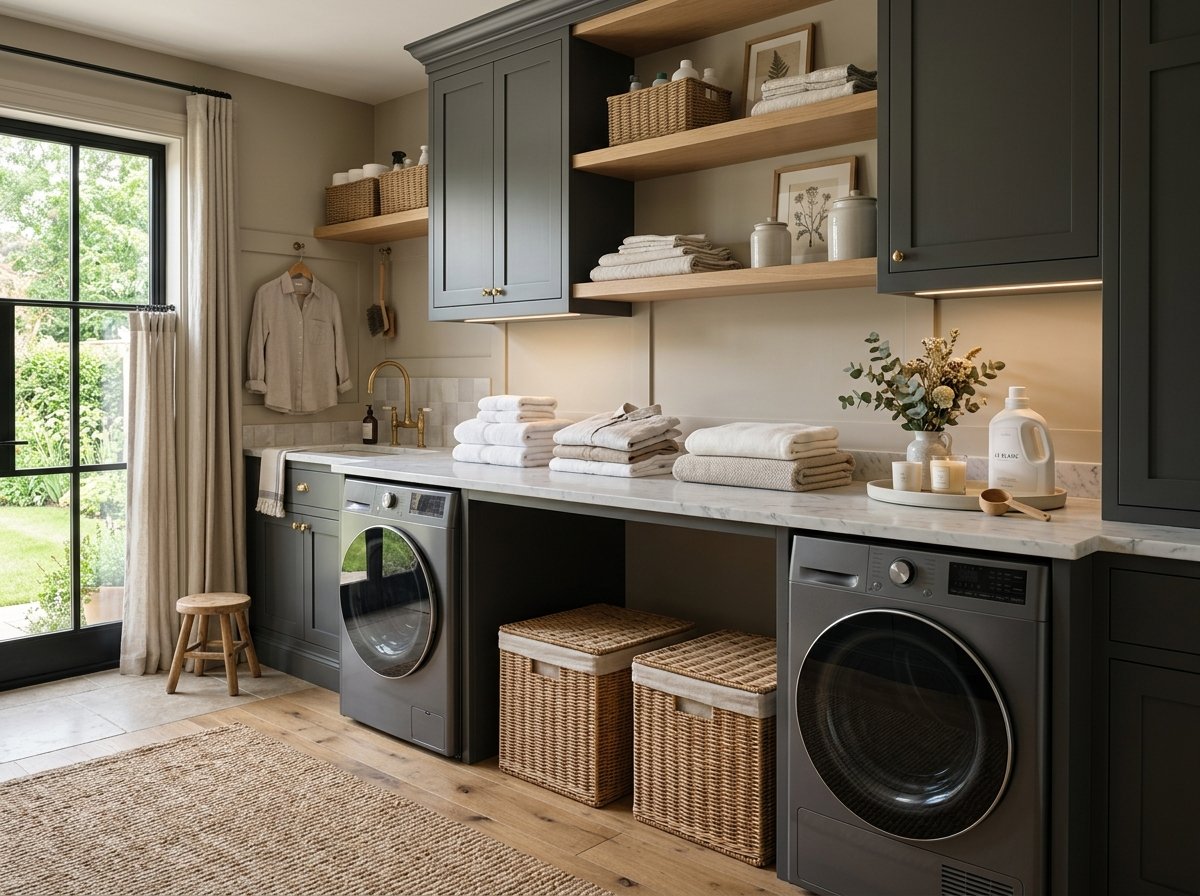
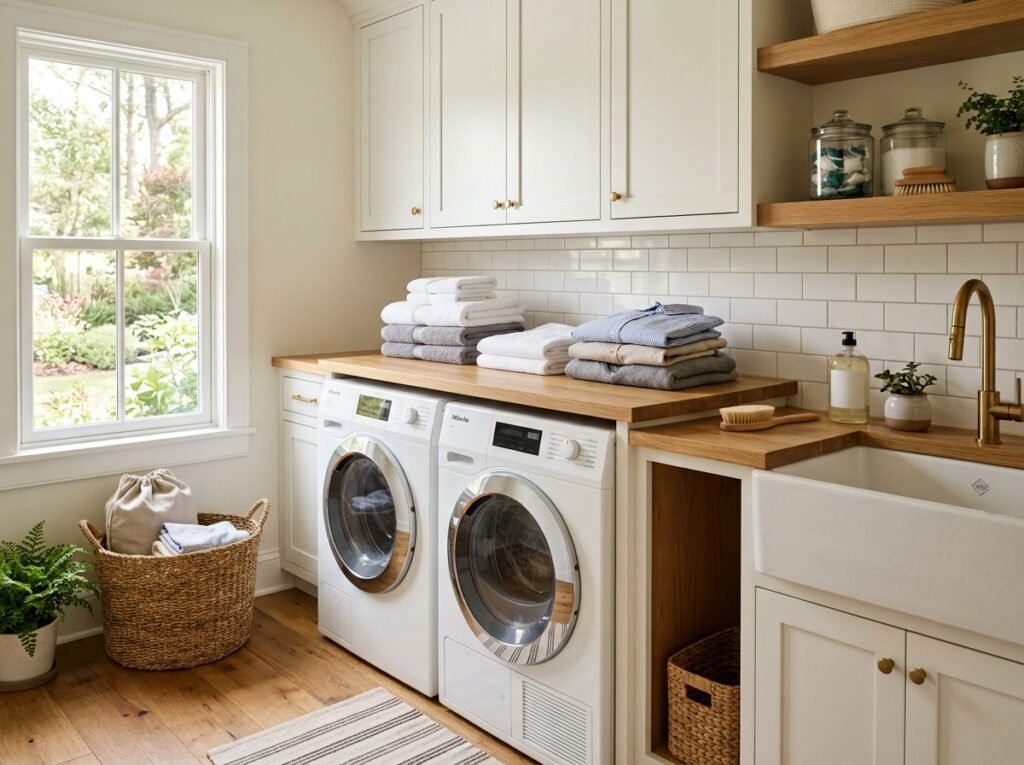
The most popular arrangement uses front-load washer and dryer units placed side by side with a countertop above them. This turns the otherwise unused area above the appliances into a practical laundry folding station.
Other options include:
- Wall-mounted folding tables
- Drop-leaf laundry tables
- Fold-down countertops
- Pull-out folding surfaces
- Portable folding tables
- Built-in cabinet countertops
- Rolling laundry carts with folding tops
- Folding tables beside stacked washers and dryers
The best choice isn’t necessarily the largest table. It is the one that gives you enough working space while preserving access to the appliances, doors, vents, hoses, and storage.
Why Add a Folding Table to a Laundry Room?
Laundry becomes much easier when every task has a designated place.
Without a folding station, clean clothes often end up on the bed, couch, kitchen table, or even the top of the dryer. That creates another chore: moving everything again.
A laundry room countertop solves that problem.
1. It creates a dedicated folding surface
You can transfer clothes directly from the dryer to the table and fold them immediately.
2. It uses otherwise wasted space
A countertop over side-by-side front-load machines takes advantage of horizontal space without requiring another piece of furniture.
3. It makes small rooms more functional
A fold-down table can provide a full work surface when needed and disappear against the wall afterward.
4. It improves organization
You can divide the surface into areas for:
- Clean clothes
- Towels
- Delicates
- Clothes waiting for ironing
- Items going to different bedrooms
5. It can make the room look finished
A properly finished wood, laminate, or stone-look countertop can make a utility room feel more like an intentional part of the home.
What Are the Best Laundry Room Folding Table Designs?
There isn’t one perfect design for every home. Your room layout should determine the table.
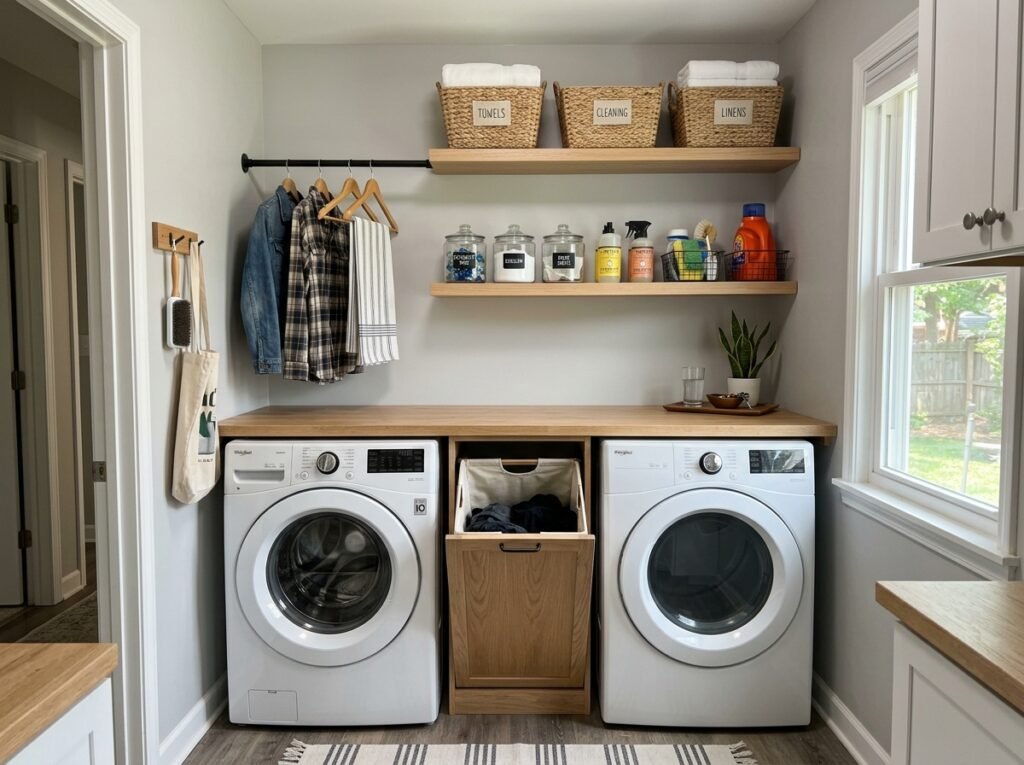
1. Over-the-Washer-and-Dryer Folding Table
This is usually the most efficient option for side-by-side front-load machines.
A solid countertop bridges the washer and dryer, creating one continuous folding station.
DIY examples commonly use plywood, butcher block, or boards supported by wall cleats and side supports. One documented DIY project, for example, used a large plywood countertop and emphasized proper priming because laundry rooms can experience moisture and humidity.
Best for: medium and large laundry rooms with front-load machines.
Main benefit: excellent use of otherwise unused space.
Watch out for: vibration, appliance access, wall structure, and ventilation requirements.
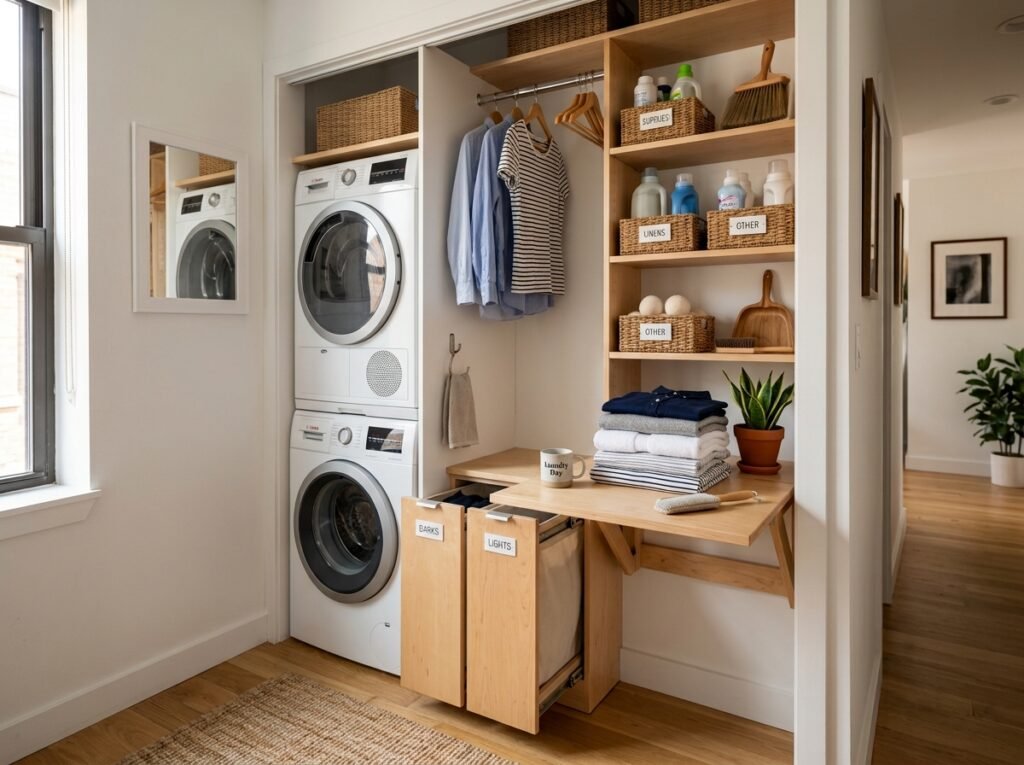
2. Wall-Mounted Drop-Leaf Folding Table
A wall-mounted folding table is one of the smartest choices for a narrow laundry room.
The tabletop hinges downward when you need it and folds vertically when you’re finished.
This design works especially well in:
- Laundry closets
- Mudrooms
- Apartment laundry areas
- Narrow utility rooms
- Small homes
A drop-leaf surface can provide useful folding space without permanently consuming floor area. Similar fold-down concepts are frequently recommended for compact laundry rooms.
Best for: small spaces.
Main benefit: disappears when not needed.
Potential drawback: requires secure wall mounting.
3. Pull-Out Folding Table
A pull-out laundry folding table works like a drawer.
You slide the surface out when you need it, fold clothes, then push it back into a cabinet or under a countertop.
This approach works especially well in custom cabinetry.
Best for: high-end laundry rooms and custom renovations.
Main benefit: hidden when not in use.
Potential drawback: more complicated and expensive to build.
4. Portable Folding Laundry Table
If you rent your home or don’t want to drill into the wall, consider a freestanding table.
You can move it around the room or fold it flat for storage.
This option also works well if your laundry room has appliances that may need frequent servicing.
5. Folding Table With Storage
You can combine the work surface with:
- Drawers
- Open shelves
- Laundry baskets
- Pull-out hampers
- Cabinets
- Ironing-board storage
This turns a basic folding table into a complete laundry room organization system.
How Do You Choose the Right Size?
Start with your appliances, not the table.
Measure the:
- Washer width
- Dryer width
- Total width
- Appliance depth
- Appliance height
- Available wall space
- Door swing
- Vent location
- Water connections
- Space needed for servicing
For example, some commercially available washer-dryer countertops are around 54 inches wide and 27 inches deep, although actual appliance dimensions vary. Current retail examples show that this is a common countertop format, but compatibility must be checked against your machines before buying.
Don’t assume that a countertop labeled “universal” will fit your exact setup.
Measure twice.
Especially if you have:
- Different-size machines
- Pedestals
- A stacked washer-dryer
- Side-mounted hoses
- A gas dryer
- A narrow closet
- Cabinets beside the appliances
Which Materials Work Best?
The material affects durability, maintenance, appearance, and price.
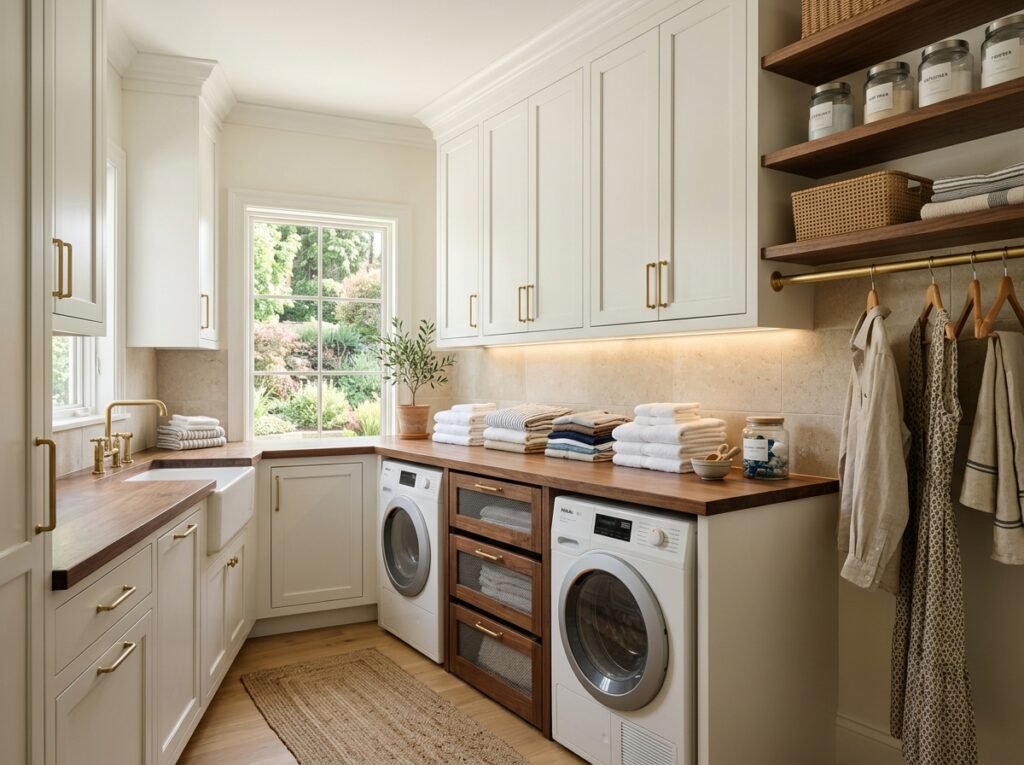
Butcher Block
Butcher block is one of the most attractive choices.
It adds warmth to a white laundry room and can be sanded or refinished later.
Pros:
- Attractive
- Strong
- Easy to customize
- Works with farmhouse and modern designs
Cons:
- Needs proper sealing
- Can be more expensive
- Water and moisture need attention
Plywood
Good-quality plywood can make an excellent DIY laundry folding table.
It is relatively affordable and easy to cut.
With careful sanding, edging, priming, and painting, plywood can look surprisingly high-end.
Laminate
Laminate is practical for busy laundry rooms.
It is easy to wipe clean and comes in many colors and patterns.
Some current washer-dryer countertops use engineered composite or laminated surfaces marketed for easy cleaning and moisture resistance.
Solid Surface
Solid-surface materials provide a polished appearance and can be highly practical, but they generally cost more than a simple DIY wood countertop.
MDF
MDF can work for painted projects, but moisture protection becomes especially important in a laundry environment.
If you choose MDF, seal exposed edges carefully.
How Do You Build a DIY Laundry Room Folding Table?
A basic DIY laundry folding station doesn’t have to be complicated.
Step 1: Measure the Laundry Area
Measure the wall, appliances, doors, vents, and surrounding cabinets.
Record everything before purchasing material.
Step 2: Decide on the Design
Choose between:
- Over-appliance countertop
- Wall-mounted folding table
- Freestanding table
- Cabinet-supported countertop
- Pull-out design
Step 3: Select the Material
For a first DIY project, plywood or a pre-finished countertop can simplify the process.
For a furniture-style result, consider butcher block or solid wood.
Step 4: Locate Wall Studs
If you’re attaching a folding table to the wall, don’t rely on drywall alone for a heavily used surface.
Find the studs and plan your mounting points accordingly.
Step 5: Install the Supports
Use properly sized wall cleats, brackets, or cabinetry to support the countertop.
A real DIY laundry project used wall-mounted 2×3 supports attached into studs and added additional support underneath the tabletop.
Step 6: Test the Fit
Before permanently securing everything, place the countertop in position.
Check:
- Washer doors
- Dryer doors
- Cabinet doors
- Wall clearance
- Hoses
- Dryer vent
- Service access
Step 7: Finish the Surface
Sand the tabletop.
Then prime, paint, stain, or seal it according to the material.
Pay extra attention to exposed edges.
Step 8: Check Stability
Push gently on the table.
It shouldn’t rock, shift, or pull away from the wall.
Step 9: Test the Appliances
Run the washer through a spin cycle.
Watch the countertop and surrounding supports.
If you notice excessive vibration, stop and investigate before using the table regularly.
What Should You Know About Washer and Dryer Clearance?
This is one of the most important parts of the project.
A folding table should work around your appliances rather than interfere with them.
Manufacturers have different installation requirements, so always check the manual for your exact model.
Whirlpool, for example, emphasizes that front-load washers need to be properly leveled and that an unlevel machine can produce excessive vibration and noise.
Samsung likewise recommends a level, solid surface for dryers and notes that installation clearances vary by appliance. Its current guidance also specifies clearance around dryers for ventilation and installation.
That means you should not simply build a table and push the machines underneath it.
Leave room for service
Your washer may eventually need:
- Hose replacement
- Drain access
- Filter cleaning
- Electrical service
- Leveling
- Appliance replacement
A removable or carefully supported countertop can make future maintenance much easier.
One laundry-room renovation used a removable countertop specifically so the homeowner could access the hoses and back of the appliances when necessary.
That is a smart detail worth copying.
How Can You Maximize Storage Around the Table?
A folding table works even better when you plan the storage around it.
Use vertical space
Install shelves above the folding station for:
- Detergent
- Dryer balls
- Stain remover
- Towels
- Cleaning cloths
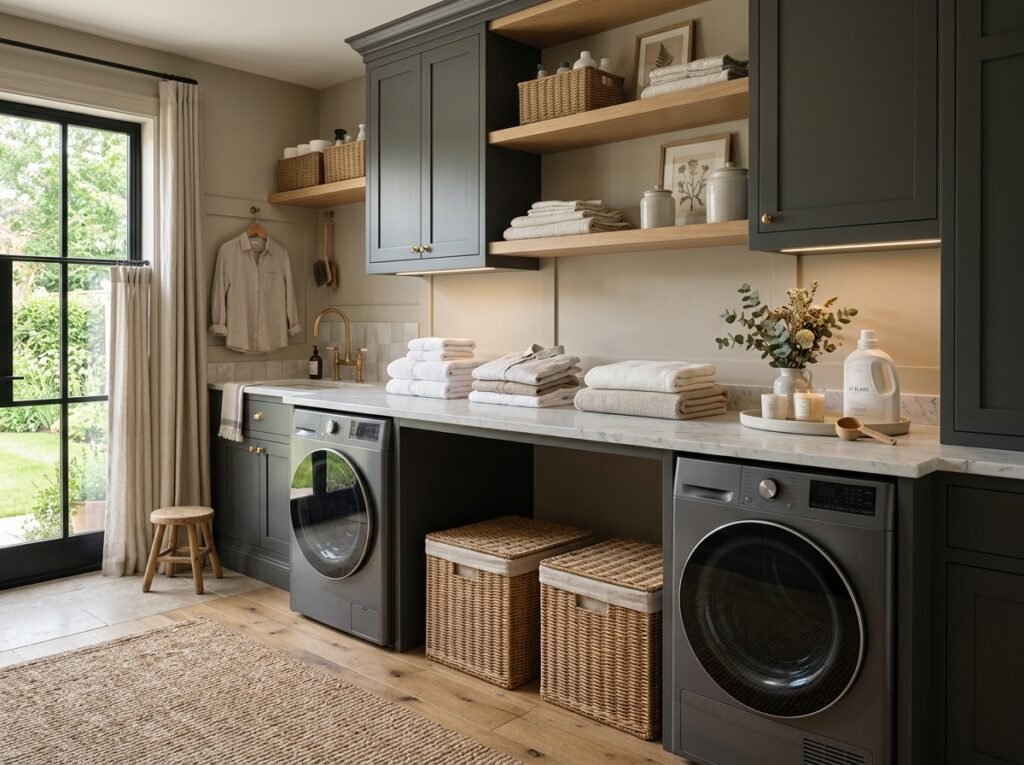
Add pull-out hampers
A cabinet with multiple laundry baskets lets you sort clothing before washing.
Install a hanging rod
A hanging rod directly above or beside the folding station gives you somewhere to hang:
- Shirts
- Dresses
- Delicates
- Clothes that wrinkle easily
Add hooks
Hooks are useful for:
- Laundry bags
- Lint rollers
- Small cleaning tools
- Ironing accessories
Keep the countertop clear
Don’t turn the folding table into permanent storage.
The whole point is to preserve usable workspace.
A good rule is simple: store vertically, work horizontally.
Can a Folding Table Work in a Smart Laundry Room?
Yes, but the table itself doesn’t need to be “smart.”
The better approach is to make the laundry room ecosystem smarter.
Modern smart-home systems can connect appliances, lighting, sensors, and routines.
For example, you could combine a folding station with:
- Smart washer and dryer notifications
- Motion-activated lighting
- Smart LED strips
- Humidity sensors
- Water-leak sensors
- Smart plugs for suitable low-power accessories
- Home-assistant routines
- Voice-controlled timers
- Wi-Fi appliance alerts
Imagine finishing dinner and receiving a phone notification that the dryer cycle has finished.
You walk into the laundry room.
Motion sensors turn on the lights.
The folding countertop is already clear.
You move the clothes directly from the dryer to the folding station.
That is where smart-home technology makes sense: it reduces friction around the physical task.
What about energy efficiency?
Smart appliances can help you monitor cycles and usage, but don’t add electronics simply because you can.
For example, a smart light over the folding table makes practical sense.
A complicated automation system controlling the tabletop itself probably doesn’t.
The goal should always be convenience, not complexity.
What about security?
A laundry room can also benefit from a water-leak sensor.
This is especially useful when the room is located:
- Upstairs
- Near bedrooms
- In a basement
- Inside a utility closet
The folding table has nothing to do with leak detection, but the complete room can be designed as a more connected home-maintenance zone.
What Are the Pros and Cons?
Pros
- Creates dedicated folding space
- Makes better use of unused space
- Helps organize laundry
- Can improve the appearance of the room
- Works well with front-load appliances
- Can be customized
- Fold-down designs save floor space
- Adds useful countertop area
Cons
- Requires careful measuring
- Poor installation can create problems
- Wall-mounted versions require solid attachment
- Countertops may interfere with appliance servicing
- Wood surfaces need protection from moisture
- Some designs cost more than expected
- Stacked appliances limit certain layouts
The biggest mistake is treating a folding table as purely decorative.
It is a working surface.
It needs to survive daily use.
How Much Does a Laundry Room Folding Table Cost?
The price can range widely.
Budget option
A simple portable folding table may be the least expensive approach.
Mid-range option
A prefabricated laminate countertop or ready-made washer-dryer countertop can offer a clean appearance without a major renovation.
Current retail examples include approximately 54-inch by 27-inch washer-dryer countertops, with listed prices varying by material, design, and retailer.
Higher-end option
Custom cabinetry, butcher block, solid surface, stone, or built-in storage can significantly increase the project cost.
Your biggest expense may not actually be the tabletop.
It may be:
- Cabinets
- Hardware
- Brackets
- Finishing
- Professional installation
- Electrical work
- Plumbing changes
- Custom storage
If you’re working with a tight budget, spend first on stability, durability, and correct fit.
You can upgrade decorative details later.
What Mistakes Should You Avoid?
Mistake 1: Building before measuring
Never assume appliance dimensions.
Measure your actual machines.
Mistake 2: Blocking ventilation
A dryer needs proper airflow and manufacturer-specified clearances.
Samsung’s installation guidance, for example, calls for specific space around the dryer, including rear clearance for venting and side/top clearance.
Mistake 3: Ignoring vibration
A washer can move during high-speed spinning.
Manufacturers stress proper leveling and stable flooring because vibration can become excessive when installation is incorrect.
Mistake 4: Permanently trapping the appliances
Your washer and dryer may need servicing.
Don’t design a countertop that makes future repairs unnecessarily difficult.
Mistake 5: Using unprotected wood
Laundry rooms can experience humidity, splashes, and occasional leaks.
Seal wood properly.
Mistake 6: Making the table too shallow
A table that looks great in a drawing may be frustrating in real life if there isn’t enough depth to fold towels or shirts comfortably.
Mistake 7: Forgetting door clearance
Check the washer and dryer doors at their widest opening.
Also check nearby closet or laundry-room doors.
Mistake 8: Turning the folding surface into storage
If every inch is covered with detergent bottles and baskets, you don’t have a folding station anymore.
You have another shelf.
Which Folding Table Is Best for Your Laundry Room?
Use this quick guide.
| Laundry Room Situation | Best Folding Table |
|---|---|
| Side-by-side front-load machines | Over-appliance countertop |
| Very small laundry closet | Wall-mounted drop-leaf |
| Rental home | Portable folding table |
| Custom renovation | Cabinet-integrated folding station |
| High-end laundry room | Butcher block or solid-surface countertop |
| Stacked washer and dryer | Wall-mounted or side folding table |
| Need hidden storage | Pull-out folding surface |
| Limited floor space | Fold-down table |
| Frequent laundry loads | Permanent countertop |
| Occasional laundry use | Portable folding table |
The right table should match how you actually use the room.
How Can You Make a Small Laundry Room Feel Bigger?
A small laundry room doesn’t need a huge countertop.
Instead, make every element do more than one job.
Try these ideas:
- Use a wall-mounted folding table.
- Choose a light-colored surface.
- Install shelves vertically.
- Use matching storage bins.
- Hide hampers inside cabinets.
- Add under-cabinet lighting.
- Use a slim hanging rod.
- Keep the floor open.
- Choose a removable countertop where appliance access matters.
- Use the back of doors for small storage.
A folding table with a shallow profile can give you useful workspace without making the room feel crowded.
How Can You Design a More Comfortable Folding Station?
Think about what happens during a normal laundry session.
You remove clothes.
You sort them.
You fold them.
You stack them.
You carry them away.
A good laundry folding station should support that sequence.
Keep your most-used items within arm’s reach.
For example:
Above the table:
Laundry detergent, stain treatment, shelves and hanging rod.
On the table:
Current laundry load.
Below the table:
Baskets and hampers.
Beside the table:
Ironing board or drying rack.
This creates a simple workflow instead of making you walk around the room repeatedly.
What Is the Best Countertop for Folding Clothes?
For most households, the best surface is one that is:
- Smooth
- Easy to clean
- Moisture-resistant
- Strong enough for everyday use
- Comfortable to work on
- Simple to maintain
Wood offers warmth.
Laminate offers convenience.
Solid surface offers a premium finish.
The “best” material depends on your budget and design style.
If you frequently fold damp towels or handle stain treatments on the table, prioritize easy cleaning and moisture resistance over appearance alone.
Can You Put a Folding Table Directly on the Washer and Dryer?
This depends on the design and manufacturer requirements.
A countertop should not interfere with the appliance’s required movement, ventilation, doors, or servicing.
Some DIY designs support the countertop from the walls or cabinetry rather than placing its weight directly on the appliances. Others use removable supports or carefully designed structures.
Because washers can vibrate significantly, I would avoid treating the tops of the machines as structural supports unless the appliance manufacturer and table design specifically allow it.
The safer approach is to create a properly supported surface that remains stable while allowing the machines to operate normally.
Is a Folding Table Worth It in a Laundry Closet?
For many homeowners, yes.
A laundry closet often has almost no spare floor space.
A wall-mounted fold-down table solves the biggest problem: you need workspace, but you don’t need workspace all day.
Fold it down while doing laundry.
Fold it back up afterward.
This simple change can make a cramped laundry closet dramatically more functional.
What Should You Put Above a Laundry Folding Table?
The wall above the table is valuable.
Consider:
- Floating shelves
- Closed cabinets
- Pegboards
- Hanging rods
- Drying racks
- Hooks
- Small LED lighting
- Wall-mounted ironing-board storage
Avoid putting heavy objects where they could fall onto the folding surface.
Keep frequently used supplies easy to reach, but store chemicals securely and away from children and pets.
How Can You Keep a Laundry Folding Table Looking Clean?
A beautiful laundry room still has to handle real laundry.
Don’t try to keep everything perfectly staged.
Instead, create designated homes for everyday items.
Use:
- Matching baskets
- Small bins
- Drawer organizers
- Hidden hampers
- Labels where helpful
- Closed cabinets for visual clutter
Then establish a simple habit:
Fold → sort → carry away → clear the table.
The final step matters.
A folding station works best when the next load always has a clean surface waiting.
What Laundry Room Folding Table Features Are Actually Worth Paying For?
Some features genuinely improve daily use.
Worth paying for
- Strong construction
- Moisture-resistant finish
- Quality hardware
- Removable access
- Proper wall support
- Built-in hampers
- Smooth drawer slides
- Easy-clean countertop
- Good lighting
Less important
- Complicated motorized mechanisms
- Unnecessary electronics
- Decorative hardware that doesn’t improve function
- Oversized countertops you don’t actually need
The best laundry room upgrade is usually the boring one that works every single day.
Frequently Asked Questions
What is the best laundry room folding table for a small space?
A wall-mounted drop-leaf or fold-down table is usually the most practical. It provides working space when needed without permanently consuming floor area.
Can I put a countertop over my washer and dryer?
Yes, many laundry rooms use countertops above side-by-side front-load machines. However, you must check the appliance installation instructions, clearances, ventilation, vibration, and service access before installing one.
What size should a laundry folding table be?
There is no universal size. Measure your machines and available space first. Commercial washer-dryer countertops commonly use dimensions around 54 inches wide by 27 inches deep, but your appliances may require something different.
Is butcher block good for a laundry room?
Yes. Butcher block can look beautiful and provide a durable folding surface, but it should be properly sealed and protected from moisture.
Is plywood good for a DIY laundry folding table?
Yes. Quality plywood can be a cost-effective option when properly supported, sanded, finished, and sealed.
Should a folding table touch the washer?
Not necessarily. A properly designed countertop can be supported by walls, cabinetry, or brackets. The exact design should account for appliance vibration and manufacturer requirements.
Can I use a folding table with stacked machines?
Yes, but the design changes. A wall-mounted table beside or near the stacked unit often works better than trying to bridge over the appliances.
How can I make my laundry room smarter?
Consider smart washer and dryer notifications, motion-activated lights, water-leak sensors, humidity monitoring, and simple home-automation routines. The goal is to make laundry easier rather than adding technology for its own sake.
Does a laundry folding table add home value?
It may improve the functionality and appearance of the laundry room, but you shouldn’t assume a specific dollar-for-dollar increase in home value. Its biggest benefit is everyday convenience.
Should the folding table be removable?
A removable countertop can be a smart choice when appliance servicing or hose access may be difficult. One real-world laundry renovation used a removable surface specifically to maintain access behind the appliances.
What Is the Final Takeaway?
A laundry room folding table is a small upgrade that can make a surprisingly big difference.
If you have side-by-side front-load machines, an over-the-appliance countertop usually gives you the most workspace for the amount of floor area used. If your laundry room is narrow, a wall-mounted drop-leaf table may be the better choice. For renters, a portable folding table offers flexibility without permanent installation.
The most important part is not choosing the fanciest countertop.
It’s getting the fundamentals right:
- Measure your appliances first.
- Follow manufacturer clearance requirements.
- Account for washer vibration.
- Use strong supports.
- Protect the surface from moisture.
- Preserve access for future repairs.
- Add storage around the workspace.
- Keep smart-home technology practical.
A well-designed folding station turns laundry from a pile of clothes waiting for attention into a simple, repeatable workflow.
And that’s really the goal: less clutter, less walking back and forth, and a laundry room that works as hard as you do.
Sources and Expert References
The installation and safety guidance in this article is based primarily on manufacturer documentation and current product information rather than unsupported design claims. Whirlpool’s guidance emphasizes leveling and stable flooring because an unlevel washer can create excessive vibration and noise. Samsung similarly recommends level, solid installation surfaces and provides appliance-specific clearance guidance.
For practical design inspiration, current laundry-room examples include over-appliance countertops, wall-mounted drop-leaf designs, portable folding tables, and integrated storage solutions.